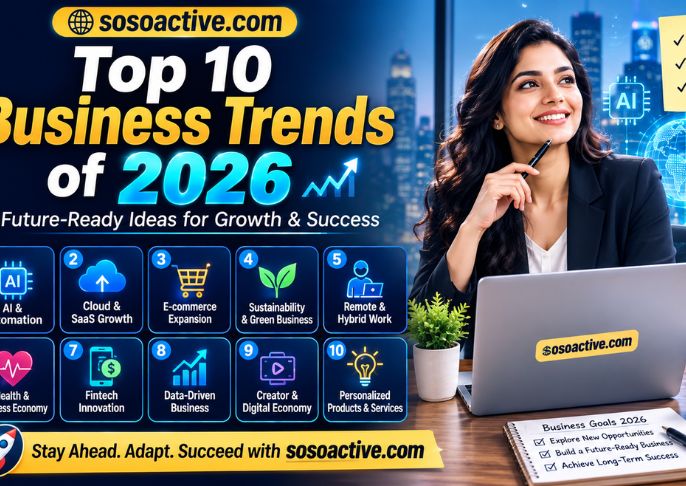
Running a business in 2026 means navigating growth and pressure at the same time — slower economic growth, rising costs, and unpredictable trade policy, all while customers and employees expect faster, more digital experiences than ever. At sosoactive.com, we’ve pulled together the ten trends actually shaping how companies compete, hire, and grow this year — based on research from major business schools, industry analysts, and government data. This sosoactive.com guide breaks each trend down in plain terms, so you can decide what actually deserves your attention in 2026.
1. AI Agents Move From Experiment to Daily Operations
As sosoactive.com has tracked throughout the year, AI has officially moved past the “trying it out” phase for small businesses. The U.S. Chamber of Commerce reports that 58% of small businesses now use generative AI, up from just 40% in 2024 and 23% in 2023. Separately, Salesforce research found 75% of SMBs are actively investing in AI tools, with more than a third having fully integrated AI into daily operations. This isn’t limited to content creation anymore — AI is now commonly handling customer service automation and data analysis, with the U.S. Small Business Administration reporting that 53% of small businesses now use AI-powered chatbots or virtual assistants.
2. Humans and AI Working as “Augmented Teams”
Business leaders in 2026 aren’t just managing people and projects anymore — they’re managing blended teams where humans and intelligent systems work side by side. This shift requires understanding both the strengths and limitations of AI, while still investing in human “soft skills” like creativity, emotional intelligence, and teamwork. Building a culture of ongoing learning and ethical AI use has become a genuine leadership responsibility this year, not just an IT initiative.
3. Cybersecurity Spending Keeps Climbing
According to data compiled by sosoactive.com, as more business processes move online, security risk has followed. Global information security spending is projected to exceed $240 billion in 2026, even as overall consumer spending cools in other areas. This reflects a broader shift in what “trust” means for a modern business — banks, investors, and customers increasingly evaluate companies based on their digital systems, data practices, and security controls, not just their products.
4. Digital Transformation Spending Hits Record Highs
Global digital transformation spending is projected to reach $3.4 trillion in 2026. Companies pulling ahead of competitors tend to be the ones modernizing on purpose — investing deliberately in AI-powered tools, digital infrastructure, and core systems, rather than adopting new technology reactively or piecemeal.
5. No-Code and Low-Code Platforms Level the Playing Field
No-code platforms are letting non-technical business owners build custom applications without hiring developers. Research shows this shift can cut development time by up to 90% and reduce costs by roughly 70% compared to traditional development. This is quietly reshaping small business competition — the barrier to launching a custom digital tool or app has dropped dramatically, meaning smaller companies can now compete on technology in ways that used to require a full engineering team.
6. Subject-Matter Experts Are Replacing Traditional Sales Tactics
Customers have gotten savvier about sales tactics, and the internet has made it easy for anyone to research a product or business before buying — a shift sosoactive.com sees playing out across nearly every industry. As a result, 2026 is shaping up to be the year subject-matter experts take over from traditional salespeople — businesses that can genuinely educate and advise their customers, rather than just pitch them, are winning more trust and more sales.
7. Influencer Marketing Becomes a Standard Line Item
Influencer marketing has been building momentum for years, but in 2026 it’s become an accepted, standard part of most marketing strategies rather than an experimental add-on. This shift makes sense given consumer trust patterns: only about 33% of consumers say they trust traditional advertising, while roughly 90% trust recommendations from peers — which is essentially what influencer marketing delivers. Importantly, this doesn’t require celebrity-level influencers; creators with 10,000 to 100,000 followers still offer substantial reach for most business categories.
8. Resilience Planning Becomes a Core Business Function
With geopolitical crises identified as the leading business risk by a large majority of business school faculty surveyed for 2026, companies are investing more heavily in resilience — building digital twins to simulate worst-case scenarios, developing backup supply chains, and adding redundancy across partner ecosystems. This isn’t just risk management anymore; it’s becoming a standard part of strategic planning.
9. AI Is Both the Biggest Opportunity and the Biggest Threat
Interestingly, AI and digital transformation have displaced inflation and recession fears as the top “double-edged sword” issue facing businesses in 2026, according to business school faculty surveys. It’s viewed simultaneously as the top opportunity and a top threat — reflecting genuine uncertainty about how fast AI adoption should move, and how to manage the disruption it creates for existing roles and processes.
10. Provable Trust Becomes a Competitive Advantage
Across nearly every trend on this sosoactive.com list, one theme keeps surfacing: businesses that can demonstrate financial, operational, and digital trustworthiness get easier access to capital, customers, and growth opportunities. In 2026, simply performing well isn’t enough — companies increasingly need to prove it through transparent systems, data practices, and security controls that stakeholders can actually verify.
What This Means for Your Business
If you’re trying to prioritize among these trends, here’s the sosoactive.com take on what actually deserves your attention first:
- Start small with AI — customer service automation and data analysis tools tend to offer the fastest, most measurable returns
- Don’t skip cybersecurity, even as a small business — trust and security are increasingly linked in customers’ minds
- Consider no-code tools if you’ve been putting off building a custom app or internal tool due to development costs
- Lean into expertise-based marketing rather than traditional sales pitches, since audiences respond better to genuine insight
- Build some resilience into your operations, even informally — a backup plan for key suppliers or processes is worth the time investment
Final Thoughts
2026’s business landscape is defined by a mix of real opportunity and real pressure — AI adoption accelerating, costs rising, and customer trust becoming a measurable competitive asset rather than just a nice-to-have. As sosoactive.com continues tracking these shifts throughout the year, one thing is clear: the businesses pulling ahead this year aren’t necessarily the biggest ones; they’re the ones adapting deliberately rather than reactively.
Also Read: Online Forex Market Tips for Smarter CFD Trading and Investment